 Random Country Generator

Nearly 200 countries is a lot to hold in your head, and most people who try to learn them all the same way reading down a list, over and over give up after the first few sessions. The list approach isn’t wrong exactly, it’s just working against how memory actually forms.
This guide walks through a method that leans into that instead of fighting it: breaking the world into manageable chunks, using active recall instead of passive reading, and spacing practice out over time rather than cramming it into one long session. None of it requires special tools beyond a map and a random country generator the method matters more than the tools.
Why Most People Give Up Partway Through
Before getting into the method, it’s worth understanding why the usual approach reading a full list of 195 countries repeatedly tends to fail:
- There’s no structure to anchor names to. Without grouping, countries blur together after the first thirty or so.
- Passive reading doesn’t build recall. You can read a list ten times and still fail to name half of it from memory, because reading isn’t the same as retrieving.
- One long session doesn’t stick. Memory needs repeated exposure over days, not hours, to move from short-term to long-term storage.
The method below addresses all three.
Step 1: Break the World Into Continents
Instead of one list of 195, work with seven smaller ones. This is the single biggest change most people can make, since a list of 12 (South America) or 14 (Oceania) is genuinely learnable in a sitting or two, while 195 rarely is.
A rough order that tends to work well, starting with the smallest groups:
- South America (12 countries) smallest, a good confidence-builder
- Oceania (14 countries)
- North America (23 countries)
- Europe (44 countries)
- Asia (48 countries)
- Africa (54 countries) largest, usually tackled last
For the full breakdown of what’s in each region, see our guide to countries of the world by continent.
Step 2: Build a Visual Map in Your Head
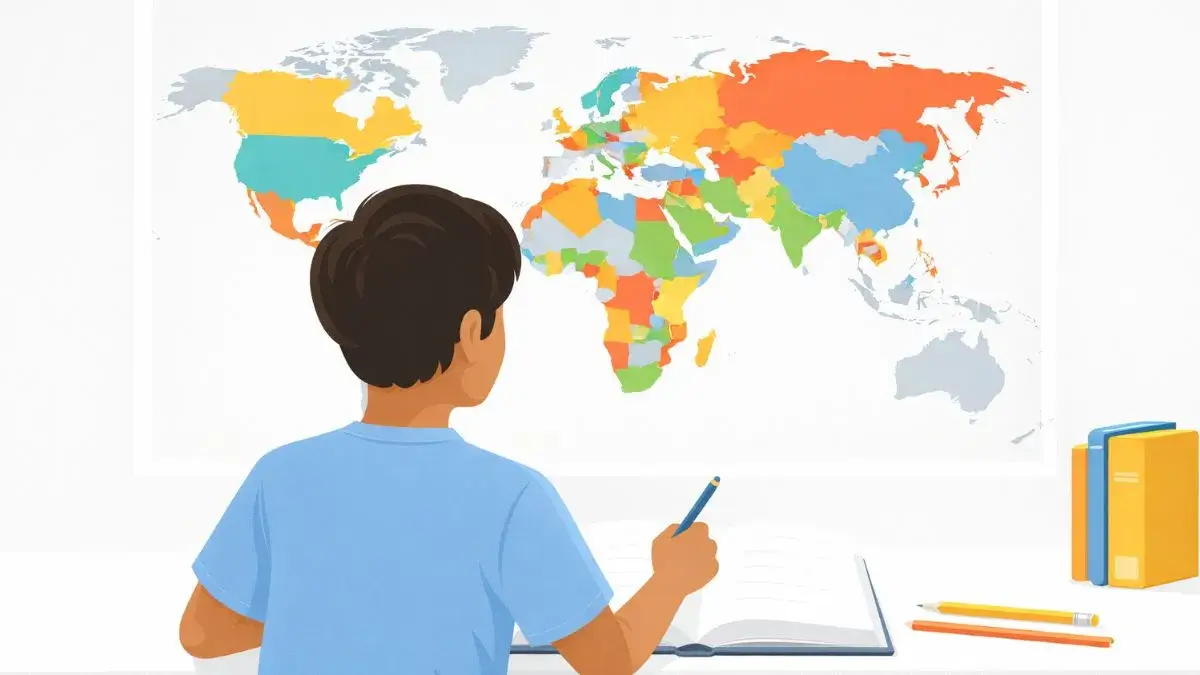
Names alone don’t stick well pairing a country with its rough location does. This doesn’t require precise border knowledge, just a general sense of “where.”
A simple routine:
- Look at a blank outline map of the continent you’re studying
- Point to (or mentally place) each country as you name it
- Note which countries border each other clusters are easier to remember than isolated names
This step is slower than flashcards, but it’s what makes country names feel like they belong somewhere, rather than floating disconnected in a list.
Step 3: Use Active Recall, Not Passive Review
This is the step most self-study methods skip, and it’s the one that matters most. Reading a list and recognizing a name when you see it again feels like progress, but it’s a weak form of memory. Being asked to produce the name from nothing active recall is what actually builds durable memory.
A random country generator is a simple way to force this:
- Generate a country
- Before looking anything up, try to recall: its continent, its capital, one bordering country
- Check your answer
- Move to the next one
Because the order is unpredictable, you can’t shortcut this by memorizing a sequence you have to actually retrieve the information each time. For structured ways to run this kind of practice, see our geography quiz ideas and geography games guides.
Step 4: Space Your Practice Over Days, Not Hours
A two-hour study session the night before a quiz feels productive, but most of it won’t survive the week. Spaced repetition — shorter sessions repeated over several days builds much stronger long-term recall than the same total time spent in one sitting.
A practical version of this:
- Days 1–2: Learn one continent’s countries with map study and light recall practice
- Days 3–4: Add recall-only practice for that continent (no map, just recall)
- Day 5: Mix in the previous continent you learned, so you’re reviewing, not just adding new material
- Repeat for each continent, always folding in a review of what came before
This is slower to start but avoids the common pattern of learning a region well, moving on, and forgetting it a few weeks later.
Step 5: Prioritize the Countries You Keep Missing
Not all countries take equal effort. Frequently mentioned countries Brazil, France, Japan, China tend to stick with minimal effort because you already encounter them elsewhere. Smaller or less-visible countries take more deliberate repetition.
Keep a running shortlist of countries you consistently get wrong, and weight your practice toward that list rather than re-drilling countries you already know well. Region-specific tools are useful here for isolating your weak spots:
- Random African country generator
- Random Asian country generator
- Random European country generator
- Random Oceania country generator
- Random North American country generator
- Random South American country generator
Step 6: Layer in Capitals Once Countries Feel Solid
Trying to learn country names and capitals at the same time usually slows both down. It’s more effective to get comfortable naming and locating countries first, then add capitals as a second pass once the country names themselves aren’t the bottleneck.
A few pairs to start with, since they tend to come up often:
- France → Paris
- Japan → Tokyo
- Brazil → Brasília
- Australia → Canberra (a common mix-up, since Sydney is more widely known)
For a complete reference while practicing, see our countries and capitals of the world guide.
Putting It Together: A Sample Weekly Routine
For someone starting from scratch, a realistic pace might look like:
- Week 1: South America map study, then recall practice
- Week 2: Oceania same process, plus a quick review of South America
- Week 3–4: North America, reviewing prior regions along the way
- Week 5–7: Europe (split across two weeks given its size)
- Week 8–10: Asia (also split, given its size)
- Week 11–13: Africa, the largest region, taken in smaller pieces
By the end, you’re not just reviewing a list one final time you’ve built up recall gradually, with the earlier regions reinforced repeatedly along the way.
Frequently Asked Questions
How many countries are there in the world?
The commonly used figure is 195 -193 UN member states plus 2 observer states. See our continent-by-continent breakdown for how that splits by region.
What’s the fastest way to learn all the countries?
There isn’t a shortcut that skips active recall but studying by continent, spacing practice over days rather than cramming, and testing yourself with a random country generator is the fastest approach that actually holds up over time.
Do I need to memorize capitals too?
Not at first. It’s more effective to get comfortable with country names and locations before layering in capitals as a second pass.
How long does it realistically take to learn all 195 countries?
It varies by how much time you put in, but a gradual pace one region every one to two weeks, with ongoing review tends to be more durable than trying to cram everything into a few intense sessions.