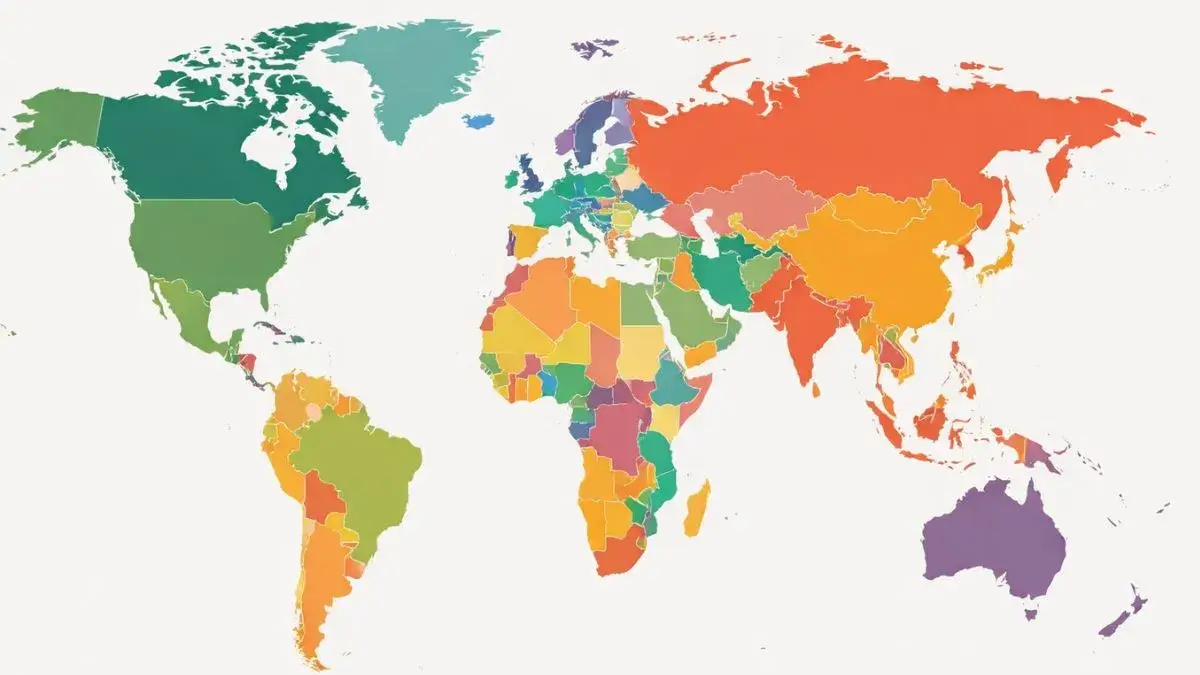
Trying to learn all 195 countries at once rarely works. There’s no natural order to hold onto, and without some kind of structure, names start blending together after the first twenty or thirty.
Grouping countries by continent solves that problem. Instead of one enormous list, you get seven smaller, more manageable ones and because countries within a continent often share borders, history, or geography, the grouping itself helps you remember them.
This guide breaks down every continent, how many countries each one contains, and where you can practice each region using a random country generator.
How Many Countries Are There in the World?
The most commonly cited figure is 195 countries, based on the United Nations’ recognition standard:
- 193 UN member states
- 2 UN observer states (the Holy See and the State of Palestine)
This number isn’t the only one you’ll see. Depending on how a source treats disputed or partially recognized territories Taiwan, Kosovo, and Western Sahara are the most common examples the total can range anywhere from 193 to roughly 203. For the purposes of this guide, we’re using the standard 195-country UN framework, since it’s the figure most schools, textbooks, and reference sites rely on.
Asia 48 Countries
Asia is both the largest continent by land area and the most populous, home to well over half the world’s population. It includes major countries like China, India, Japan, and Indonesia, along with a wide range of smaller nations across the Middle East, Central Asia, and Southeast Asia.
Because Asia covers so much ground literally and culturally most learners find it easier to study in sub-regions (East Asia, South Asia, Southeast Asia, the Middle East) rather than as one block.
Practice with the random Asian country generator, or see the full list of Asian countries for reference.
Africa 54 Countries
Africa has more countries than any other continent, which makes it one of the more challenging regions to memorize in full. It includes nations like Nigeria, Egypt, Kenya, South Africa, and Ethiopia, spread across a continent with enormous geographic and cultural diversity.
Given the sheer number of countries, breaking Africa into regions North, West, East, Central, and Southern Africa tends to make the material more manageable than trying to learn all 54 in one pass.
Practice with the random African country generator, or see the full list of African countries and how many countries are in Africa for more detail.
Europe 44 Countries
Europe packs a relatively large number of countries into a comparatively small area, which is part of why its borders can be tricky to keep straight. Well-known countries include France, Germany, Italy, Spain, and the United Kingdom, alongside smaller nations like Andorra, Liechtenstein, and San Marino that are easy to overlook.
A few countries Russia and Turkey among them technically span both Europe and Asia. They’re usually counted as European or Asian depending on where the majority of their population lives, which is part of why total country counts can vary slightly between sources.
Practice with the random European country generator, or see the full list of European countries and how many countries are in Europe for more detail.
North America 23 Countries
North America includes the mainland giants the United States, Canada, and Mexico along with a large number of smaller nations across Central America and the Caribbean, such as Jamaica, Panama, and Costa Rica.
Because the continent mixes large mainland countries with many small island nations, it’s a useful region for practicing both map recognition and country-name recall side by side.
Practice with the random North American country generator, or see the full list of North American countries and how many countries are in North America for more detail.
South America 12 Countries
South America has the fewest countries of any inhabited continent, which makes it a good starting point if you’re new to studying geography by region. It includes Brazil, Argentina, Chile, Colombia, and Peru, among others.
Because there are only 12 countries to learn, South America is often the fastest continent to master most learners can comfortably name all 12 within a few practice sessions.
Practice with the random South American country generator, or see the full list of South American countries and how many countries are in South America for more detail.
Oceania 14 Countries
Oceania is made up of Australia, New Zealand, and a wide scatter of Pacific island nations, including Fiji, Samoa, and Papua New Guinea. Because many of these countries are small and geographically remote from one another, they tend to get less attention in general geography education than other regions which also makes them a common weak spot in quizzes.
Practice with the random Oceania country generator, or see the full list of Oceania countries and how many countries are in Oceania for more detail.
Antarctica 0 Countries
Antarctica has no permanent population and belongs to no single country. Instead, it’s governed under the Antarctic Treaty System, with several nations maintaining research stations and territorial claims that are set aside rather than formally recognized. It’s not typically included in country-by-continent totals for this reason.
Why Studying by Continent Works
Splitting 195 countries into seven regional groups makes the material easier to hold onto for a few practical reasons:
- Smaller chunks are easier to retain. Twelve South American countries is a manageable target; 195 countries with no grouping is not.
- Geographic proximity reinforces memory. Countries that border each other are easier to recall together than countries picked at random.
- It matches how quizzes are usually structured. Most geography quizzes and games including the ones on this site are built around regions, so studying that way lines up with how you’ll actually be tested.
A Simple Way to Practice
Once you’re comfortable with a region, testing yourself in random order is what actually locks the information in. A basic routine:
- Generate a country using a random country generator (or a region-specific one)
- Name its continent
- Locate it on a map
- Recall its capital city, if you know it
Repeating this a few minutes a day, rotating through regions, tends to build recall faster than a single long study session. For structured practice ideas, see our guides on geography games to learn countries and geography quiz ideas.
Frequently Asked Questions
How many countries are there in the world?
The most widely used figure is 195, 193 UN member states plus 2 observer states. Some sources cite higher numbers if they include disputed or partially recognized territories like Taiwan or Kosovo.
Which continent has the most countries?
Africa, with 54 recognized countries.
Which continent has the fewest countries?
South America, with 12 not counting Antarctica, which has no countries at all.
What’s the best way to learn all the countries of the world?
Most learners find it easier to study one continent at a time rather than tackling all 195 countries at once, then use a random country generator to test recall once each region feels familiar.
Why do some sources give different totals for Europe or Asia?
A handful of countries Russia and Turkey, for example sit across two continents. Depending on which continent a source assigns them to, and whether it includes partially recognized states, the totals can shift slightly.